Rose-breasted Grosbeak
Seen one? Add it to your free UK BirdedexHear its song and see the mapFree, no app download. Epic bird: +20 points when you log it.
Rose-breasted Grosbeak in the UK
Rose-breasted Grosbeak is a transatlantic vagrant. It breeds in North America and winters as far south as South America, and the birds that reach Britain have been swept across the Atlantic during autumn migration. The first British record was on St Agnes, Isles of Scilly, from 6 to 11 October 1966. There have been just over 30 since. About half were on Scilly, with others in Wales, Scotland and a scatter of English counties from Devon to Norfolk and Yorkshire. Recent birds include Shetland and Tiree in 2021. Most have been first-winter birds, and it remains a national rarity.
Where and when to see a Rose-breasted Grosbeak
October on the Isles of Scilly is the classic time and place, usually after a run of westerly gales. Other records are spread around the western seaboard, from Lundy, Skokholm and Bardsey to the Outer Hebrides and the Northern Isles. Birds feed on berries and seeds in hedges, gardens and weedy fields and can turn up at feeders. Most stay only a few days. Watch the Atlantic weather charts in late September and October, and follow the bird news services if you are within reach of the south-west.
Habitat, diet and field notes
Habitat: Trees (vagrant).
Diet: Seeds, fruit.
Field note: Heavy bill; pink breast on male.
How to identify a Rose-breasted Grosbeak
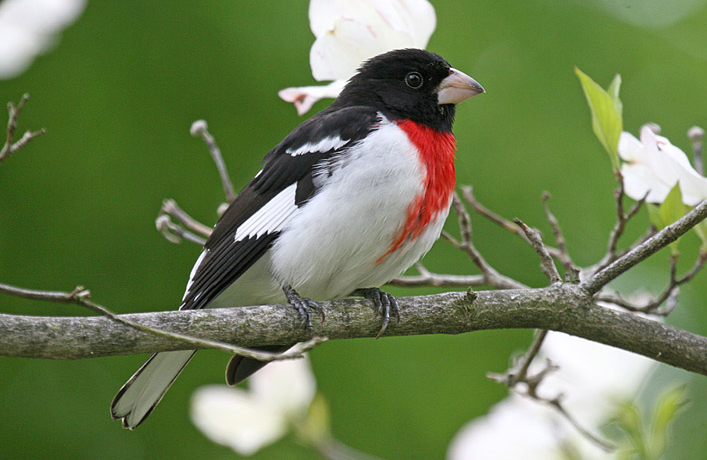
About the size of a Starling but heavier, with a big head and a massive pale, conical bill. Autumn birds here are brown and streaky above, like an oversized female finch, with a striped head: dark crown sides, a bold white stripe over the eye and a pale central crown stripe. Two white wingbars show clearly. The underparts are buff-white with dark streaks. First-winter males usually show a pink wash on the breast and rose-pink under the wing, where females are yellow. The adult male, black and white with a rose-red bib, is very unlikely in a British autumn.
Call and song
The call is a sharp, squeaky 'pink' or 'eek', a little like a woodpecker or a trainer on a gym floor. Vagrants call now and then in flight or from cover. The rich, thrush-like song is not heard in Britain. Heard something you cannot place? Bird Hear identifies UK birds from a 10 second recording, free in your browser.
Confusion species
- Hawfinch: Hawfinch has a similar huge bill but is unstreaked, with an orange-brown head, a black bib and a broad white wing band.
- Common Rosefinch: A young Common Rosefinch is streaky brown too but far smaller, with a plain face, a beady eye and a small stubby bill.
Related guide Rare birds in the UK.
Conservation status and Birdedex points
In the Birdedex the Rose-breasted Grosbeak is an Epic tier bird, worth +20 points when you log one. It is not on the Red or Amber lists in Birds of Conservation Concern 5.
Recent UK sightings
No community sightings logged for this species yet. Log the first one.
Similar birds
- Red-eyed VireoEpic · Mature trees (vagrant)
- American RedstartLegendary · Trees (extreme vagrant)
- Baltimore OrioleLegendary · Trees
- Bay-breasted WarblerLegendary · Trees (extreme vagrant)
- Blackburnian WarblerLegendary · Trees (extreme vagrant)
- Chestnut-sided WarblerLegendary · Trees (extreme vagrant)
Rose-breasted Grosbeak: quick answers
Has a Rose-breasted Grosbeak ever been seen in the UK?
Yes, a little over 30 times since the first on Scilly in 1966. Ireland has its own records, including birds in County Cork in 2021 and 2023. Nearly all arrive in October.
Where can I see a Rose-breasted Grosbeak in the UK?
Scilly in October gives the best odds, and they are still long odds. The first was on St Agnes, and St Mary's has had birds too. Elsewhere the pattern is single birds on western islands and headlands, with the occasional one in a garden far from the coast.
What does a Rose-breasted Grosbeak eat?
A mix of insects, wild fruit and seeds. Beetles make up a large part of the summer diet in North America. Vagrants here feed on blackberries, elderberries and other autumn fruit, and will take sunflower seeds.
Kit that helps
Bird ID starter kit. Affiliate links, our own picks, no extra cost to you.
Log a Rose-breasted Grosbeak in your free UK Birdedex